The Future of Luxury Travel — why the industry's most valuable product can no longer be built with a document invented for logistics.
According to Arival and Phocuswright, only 33% of experience bookings were made online in 2025, compared with 64% across the wider travel industry. The fastest-growing segment of travel remains the least digitized, the least connected and, in many cases, still assembled manually. This is more than a technology gap — it reveals that the industry’s most valuable product is still being created through fragmented processes.
Research from McKinsey & Company explains why this matters. The range and quality of local activities, together with the opportunity to experience authentic local culture, now rank among the leading factors influencing destination choice. The experience is no longer something added to a trip after the destination is chosen. Increasingly, it is the reason the destination is chosen at all.
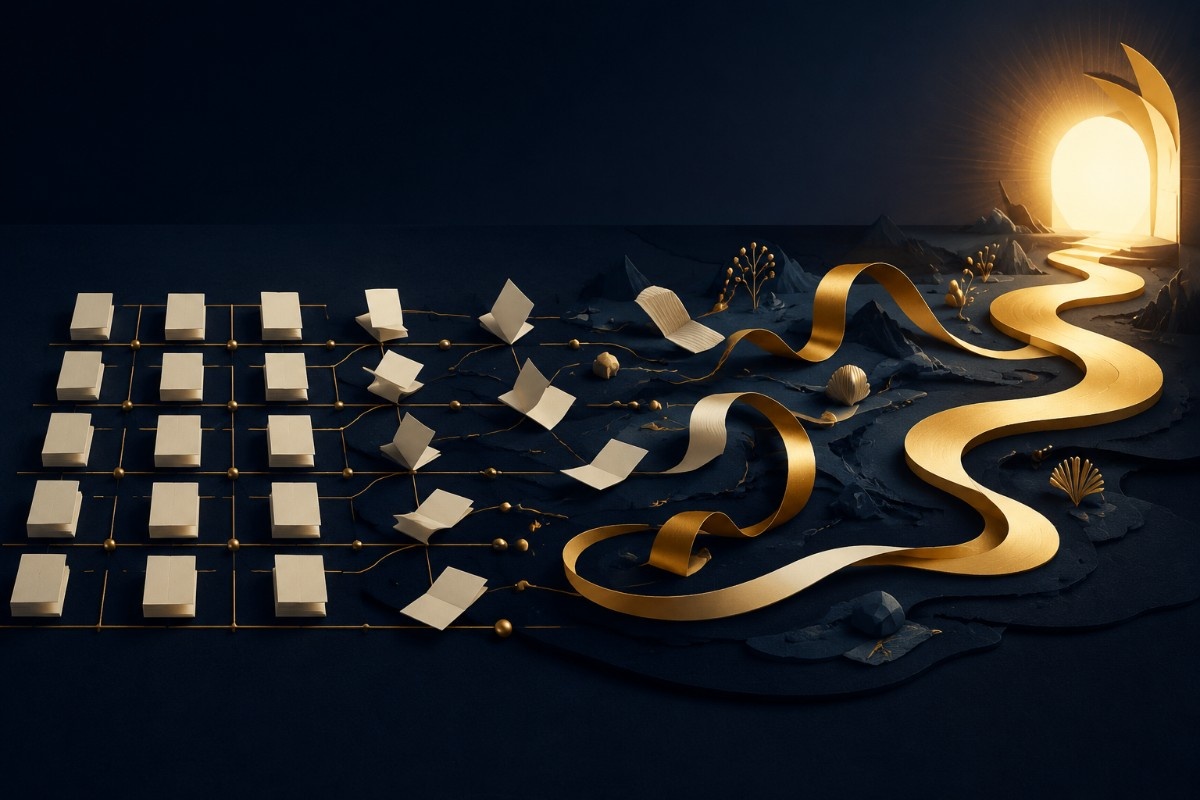
An itinerary is an output. An experience is designed.
An itinerary asks
Logistical questions
- Where?
- When?
- How long?
A bespoke experience asks
Different ones entirely
- What should the traveler feel?
- What rhythm should the journey have?
- Which moments deserve anticipation?
- Which deserve surprise?
- What will they remember years later?
Experiences cannot simply be booked. They must be designed.
Experience design is the discipline of transforming a traveler’s aspirations, emotions and purpose into a coherent luxury journey where every element contributes to a single vision. It is neither travel planning nor itinerary building. It is the intentional creation of experiences that cannot simply be booked — they must be designed.
The problem is that this creative discipline remains trapped inside operational work. Designing a bespoke experience requires creativity. Yet much of the professional’s time is consumed not by creativity, but by searching, comparing, validating and assembling information scattered across supplier websites, emails, notes, spreadsheets and disconnected systems before the real design work can even begin.
Expedia Group’s Path to Purchase Research offers a sense of the scale. Travelers themselves spend an average of 303 minutes reviewing 141 pages of content before booking a single trip. For the luxury travel professional, that research burden multiplies across every traveler, every destination and every request. In practice, creating a complete bespoke proposal — with experience design, suppliers, budgets and presentation — can still consume one to two days of highly skilled work.
Demand is moving toward designed experiences. The process for creating them is still built for itineraries. Designing at the Speed the Market Now Moves
This contradiction is precisely what The Key AI was created to resolve.
The Key AI is an intelligence layer designed to support the professionals behind exceptional journeys — reducing the time spent on research, investigation, planning, structuring and presentation while preserving the expertise, judgment and creativity that define luxury service.
At the heart of The Key AI is Bespoke Experiences Studio (BES) — an intelligence studio created specifically for the design of bespoke luxury experiences. Unlike traditional travel planning software, which focuses on managing bookings and itineraries, BES was designed around a different philosophy.
Every experience begins with a creative brief. Beyond the destination, duration, number of travelers and budget, the professional defines the aspirations, desired atmosphere, emotions, travel style, interests and preferences that should shape the experience.
From that creative brief, BES designs a complete bespoke experience, intelligently combining destinations, accommodations, private services, experiences and trusted providers into one cohesive concept tailored to that specific traveler’s request.
The professional remains in complete control — reviewing, refining, replacing recommendations, introducing preferred suppliers and shaping every detail before presenting the final experience to the traveler.
The result is ready to deliver: a branded presentation that can be shared directly with the traveler, together with a fully editable document containing the complete experience, budgets and margin calculations, with the flexibility to transfer everything into the professional’s own templates and workflows.
Ready in under 30 minutes instead of one to two days. The Itinerary Is Not Disappearing. It Is Being Demoted.
Luxury travel is no longer defined by who can assemble the best itinerary. It is defined by who can design the most meaningful experience.
Sources
- Arival & Phocuswright — Experiences Surging Toward US$342 Billion
- McKinsey & Company — The Way We Travel Now / The Evolving Role of Experiences in Travel
- Expedia Group — Path to Purchase Research